Blog
Tesla's Roadster is the ultimate mog, and the brand strategy lesson of the year
Summary
Tesla just made a car fly to sell everything else it makes. For founders, it's a brand strategy lesson in how performance has replaced advertising, and why the halo goes to whoever proves they lead.

Written by Rick Julian, founder and brand strategist at QV Brands. 25+ years leading strategy and creative across major launches; author of THE WAY and co-writer of the Billboard #1 jazz single "Be Beautiful."
Prefer to talk? Call (404) 688-0088, by appointment, Mon–Fri 9–5.
On October 15, Tesla flew a car. At a SpaceX test site near Waco, Texas, the new Roadster drove up a curled ramp, hung upside down, flipped itself with cold-gas thrusters and landed on its wheels. If you work in brand strategy, that wasn't a product launch. It was proof that performance has replaced advertising: one undeniable act that casts a halo over everything else the company does.
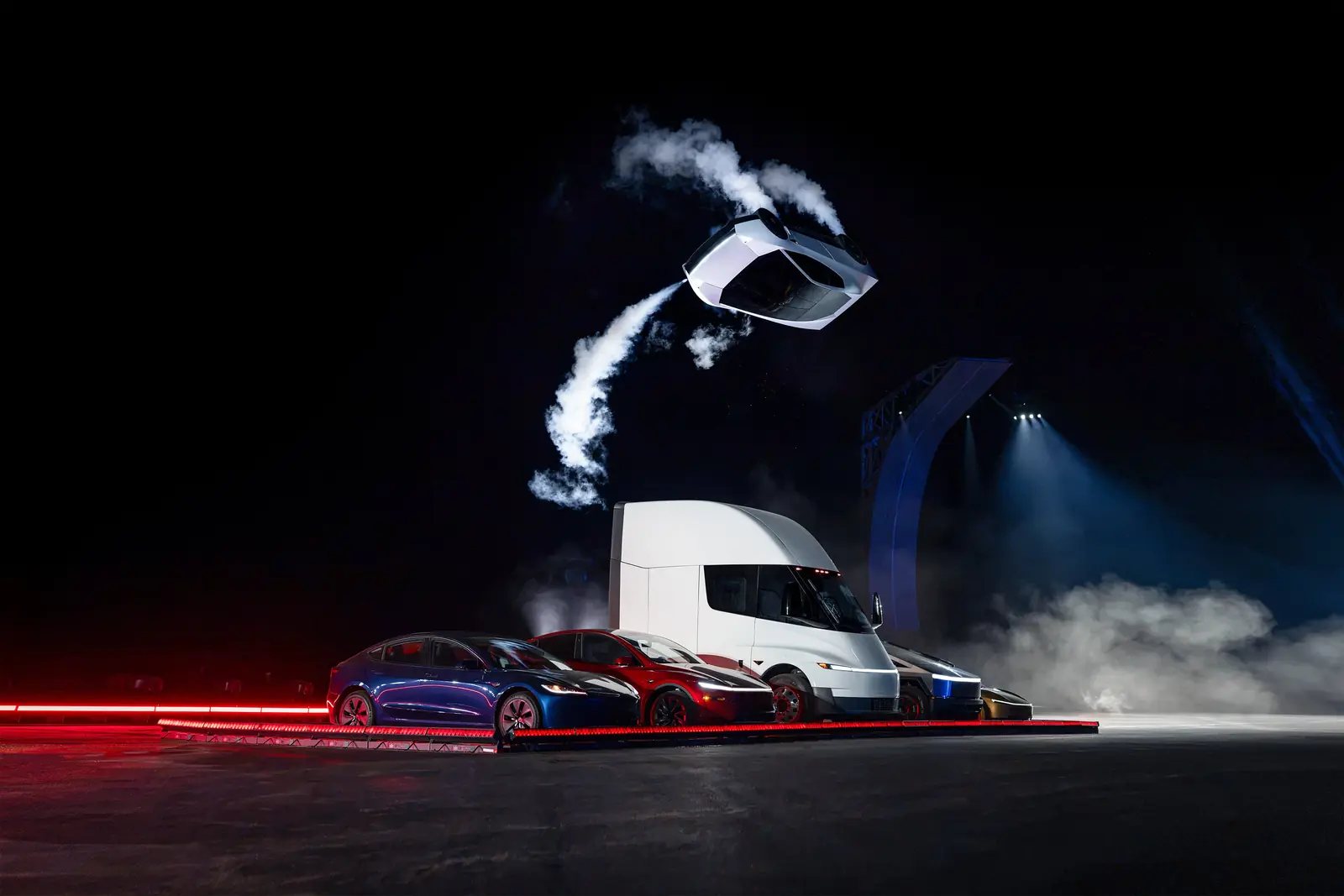
The show ran less than half an hour. After the ramp, the Roadster hopped over a row of Teslas, Model 3, Model Y, Cybertruck, Semi and Cybercab, in a move Tesla's engineering VP Lars Moravy called a kickflip. Tesla claimed 0 to 60 mph in 0.81 seconds. The long-rumored "SpaceX package" turned out to be real: fans underneath that suck the car to the road, and thrusters that lift it off. Musk called the car "what happens when you have a collaboration with the world's best car company and the world's best rocket company," and posted the line everyone repeated by morning: "Turns out the future does have flying cars."
What makes the Roadster the ultimate mog?
The Roadster is the ultimate mog (slang for outshining the competition). It doesn't argue. It stands next to its rivals and lets the comparison do the work. Rimac, Porsche and BYD spent the last nine years building electric hypercars that set the pace while the Roadster sat in development. None of them flew. The conversation is over.
Here's the part that matters for brand strategy. Musk has called the Roadster a "small potato situation" that won't move the needle financially. He's right, and that's the point. The flagship Rocket trim seats one, is invite-only, and Tesla says it isn't approved for public road use. Musk says production starts in 2028, for a car first teased in 2017 with deliveries promised for 2020. None of that dents the move, because the Roadster's job was never to sell Roadsters. Its job is to make every Model Y in every driveway feel like it came from the company that makes cars fly.
That's the mog halo. When a brand executes something this improbable, the market quietly upgrades its estimate of everything else the brand does. If they can make a car hang inverted and kickflip a Semi, the reasoning goes, they can probably handle batteries, autonomy and robots. Fair or not, that's how people assign competence. They generalize from the most impressive thing they've seen.
Why does brand performance beat advertising?
The old notion of advertising was a claim plus a media budget. Say you're the best, repeat it until people believe it, pay for the reach. The Roadster inverts that. The demo itself is the media. Tesla livestreamed it on X, and its "Real life, baby" clip passed 61 million impressions in under a day. That reach wasn't bought. People passed it around because it was undeniable, and undeniable is the one thing a paid claim can never be.
The flex also isn't really speed. It's ease. Tesla added a flip, a hover and a kickflip over its own lineup, twists with no commercial purpose except to show how much fun it is to lead the world in innovation. Musk said the car "takes the fun meter to 11 out of 10," and admitted it's "not necessarily a safety-optimized car." That playfulness is the message. A company this far out front has room to play. When a leader does a stunt, it reads as confidence. When a follower does one, it reads as desperation. Competence plus delight is about the most persuasive signal a brand can send, and you can't fake either half.
I've spent 25 years in rooms where brands tried to buy what Tesla just demonstrated. The ones that won usually stopped describing their competence and started showing it.
What can founders take from Tesla's brand strategy?
You don't need a rocket company. You need a Roadster: one proof point so clearly beyond your category that it reframes everything else you sell. For a consultant it might be a diagnostic nobody else offers. For an expert practice, a public piece of work peers keep citing. For a founder, it's often the website itself, the one in your category that actually behaves differently. That's brand positioning by performance instead of by adjectives.
Then brand strategy does the rest. A halo only lands on what's standing nearby. Tesla's demo worked because the whole lineup was parked under the flying car, so the glow had somewhere to go. If your proof point is disconnected from your core offer, it's just a stunt. Name the flex, tie it to what you sell, and say it the same way everywhere so the messaging carries it to every page, pitch and conversation. It's the same reason strategy is the new logo: the signal that matters is what you can prove, not what you decorate.
That's the job of brand strategy now. Not louder claims, but a deliberately designed act of performance and a growth system that carries its glow to everything you make. It's the principle behind every custom website and growth system we build for founders at QV Brands in Atlanta.
Clarity is a growth strategy. Sometimes it flies.
Related
Ready for strategic clarity?
A strategy call is the simplest way to start — direct, no pitch, thirty minutes.
Book a strategy callPrefer to talk? Call (404) 688-0088, by appointment, Mon–Fri 9–5.